


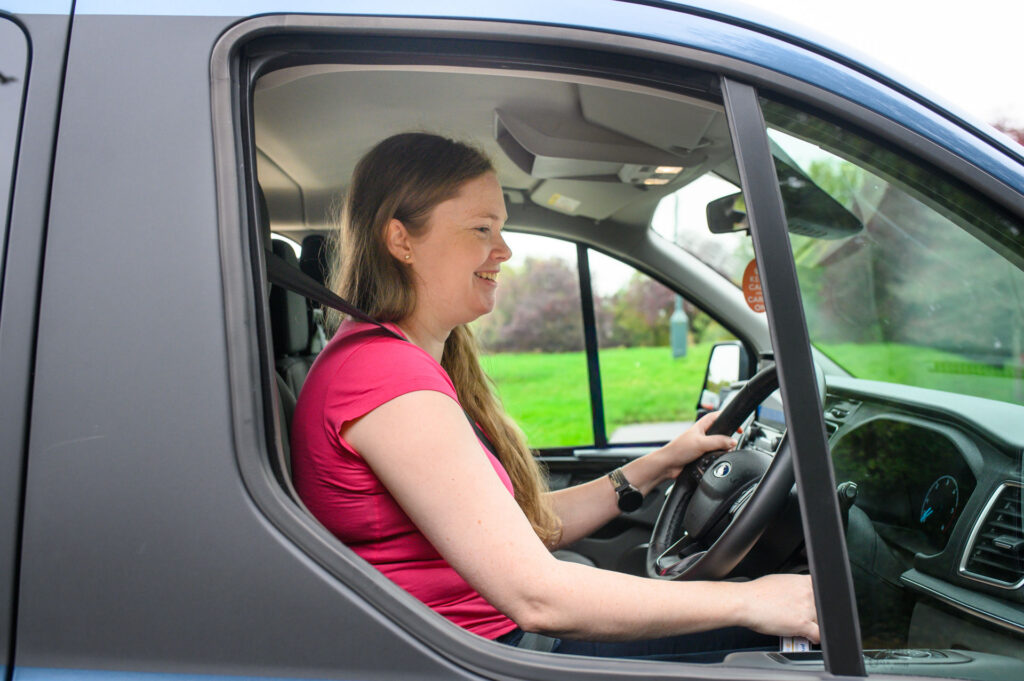
Choosing an accessible vehicle can feel complicated, particularly if you are hiring one for the first time. A wheelchair accessible vehicle (WAV) that works brilliantly for one person may be unsuitable for another.
For a WAV, your wheelchair size matters. So does the number of people travelling, the equipment you need to carry, whether you transfer from your wheelchair, who will be driving and the types of journeys you usually make. And there are some vehicles with features that are for access needs unrelated to wheelchair usage.
That is why ORA offers more than one type of mobility vehicle.
Our fleet includes small, medium and large wheelchair accessible vehicles (WAVs), internal transfer vehicles and adapted cars, giving us more options to match the vehicle to the person using it.
Here is a closer look at the different types of vehicle available and when each one might make sense.
Small wheelchair accessible vehicles
Small WAVs can be a practical option when you need wheelchair access without a particularly large vehicle.
They are often well suited to everyday journeys, including shopping, appointments, visiting friends and family or getting around towns and cities. Models within this category can include vehicles such as the Peugeot Horizon and Citroën Berlingo, professionally converted by specialist WAV providers.
Different conversions mean the exact layout and wheelchair space can vary between vehicles, so matching the vehicle to your wheelchair remains important.
A small WAV could suit you if you:
- usually transport one wheelchair user
- want a compact vehicle that is easier to park
- mainly make shorter or urban journeys
- do not need lots of additional passenger or storage space
- want something that feels closer in size to an everyday car
Small WAVs typically use a lowered floor and access ramp to make wheelchair entry easier, alongside wheelchair restraints and occupant safety systems. Approximate wheelchair spaces across this part of the fleet can range from 48 to 52 inches in height, 24 to 27 inches in width and 40 to 47 inches in length.
These measurements vary by model and conversion, so they should always be treated as a guide rather than a guarantee that a particular wheelchair will fit.
Medium wheelchair accessible vehicles
Need a little more room? Medium WAVs sit between compact wheelchair accessible vehicles and the largest vehicles in the fleet.
That extra space can make a significant difference if you use a larger wheelchair or powerchair, travel with several other people or regularly carry mobility equipment and luggage. ORA’s medium WAV range can include models such as the Ford Connect, Volkswagen Caddy Maxi and Vauxhall Combo, alongside similar professionally converted vehicles.
They are often a useful balance between interior space and everyday manoeuvrability.
A medium WAV could suit you if you:
- use a larger wheelchair or powerchair
- regularly travel with additional passengers
- need more room for mobility equipment or luggage
- make longer journeys
- want more interior space without moving to one of the largest WAVs
Depending on the individual vehicle, features can include lowered floors, wheelchair access ramps, higher roof clearance, wider entry points and additional storage space.
Approximate wheelchair spaces can range from 48 to 54 inches in height, 24 to 30 inches in width and 40 to 52 inches in length. Again, the exact dimensions and seating layout depend on the vehicle and conversion.
Large wheelchair accessible vehicles
Large WAVs are designed for people who need more room for passengers, larger wheelchairs, mobility equipment or support while travelling. They can also work well for families, care providers, support organisations and group travel.
ORA’s large WAV fleet can include vehicles such as the Ford Custom and Renault Trafic, alongside other similar models adapted by specialist converters.
The additional interior space gives much more flexibility around seating and wheelchair positioning.
A large WAV could suit you if you:
- use a large wheelchair or powerchair
- need to carry several passengers
- need space for more than one wheelchair user
- travel with mobility aids, medical equipment or substantial luggage
- regularly take longer journeys
- need a vehicle with a lift or greater entry clearance
Depending on the model and conversion, large WAVs may include ramps or wheelchair lifts, wide and tall entry points and flexible passenger seating.
Approximate wheelchair spaces can range from 48 to 56 inches in height, 24 to 30 inches in width and 40 to 52 inches in length. A larger vehicle does not automatically mean a better fit, though. Wheelchair position, passenger seating and equipment all need to be considered together.
Some large WAVs also have two wheelchair spaces, which can be great if a group of wheelchair users want to travel together.
Internal transfer wheelchair accessible vehicles
For wheelchair users who drive and transfer into a standard driving seat, an internal transfer vehicle can provide another option. These vehicles allow you to enter in your wheelchair, transfer into the driver’s seat and store your wheelchair inside the vehicle without having to transfer outside.
ORA’s internal transfer vehicles are generally based on larger, high roof models such as the Ford Transit and are professionally adapted for disabled drivers.
Depending on the individual vehicle, features can include:
- powered wheelchair lifts
- automatic rear doors
- spacious interiors with greater roof clearance
- push and pull hand controls
- wheelchair storage space
- grab handles or other transfer support
- additional passenger seating
A typical ORA internal transfer vehicle has an approximate entry height of 65 inches, internal width of 46.5 inches and internal length of 78 inches. Specifications can vary across the fleet.
How does an internal transfer vehicle work?
The exact process will depend on the vehicle and your own transfer method, but you may:
- Enter the vehicle using the wheelchair lift.
- Move into the correct position inside the vehicle.
- Transfer from your wheelchair into the driving seat.
- Secure or store your wheelchair.
- Drive using the vehicle controls and any adaptations you require.
Some drivers use equipment such as a transfer board to support this process. Internal transfer vehicles can also provide a useful way to try this type of driving setup before making a longer term vehicle decision.
Adapted cars
Some disabled drivers can transfer into a standard car seat and may find an adapted automatic car more suitable than a WAV.
ORA’s adapted vehicle fleet includes models such as the MG ZS, Toyota C-HR and Toyota Corolla, with professionally fitted driving adaptations. Two of the adaptations commonly available within the fleet are left foot accelerators and push and pull hand controls.
Left foot accelerators
A left foot accelerator can allow someone who cannot comfortably or safely operate a standard right foot accelerator to control acceleration using their left foot.
ORA vehicles can use twin folding pedal systems, allowing either the standard accelerator or left foot accelerator to be selected. This can also make the vehicle suitable for more than one driver.
Push and pull hand controls
Push and pull hand controls allow acceleration and braking to be operated by hand.
Typically, the driver pulls the lever to accelerate and pushes it to brake. The original pedals can remain available, meaning another driver may still be able to use the vehicle conventionally. Some hand control systems can also include features such as an integrated indicator switch.
Adapted car hire can be useful for everyday driving, temporary mobility needs or trying an adaptation before deciding whether it works for you longer term.
Premium vehicles with accessibility features
For some drivers who aren’t wheelchair users and don’t require adaptations installed on their vehicle, that doesn’t mean they don’t have access requirements. More and more premium vehicles are coming with accessibility features like lane assist and fatigue monitoring systems. At ORA, we know that these vehicles are sometimes recommended by a person’s doctor or clinical team when someone is returning to driving after a mild to moderate brain injury, as an example.
For wheelchair users – what size WAV do I need?
Small, medium and large are useful starting points, but vehicle size alone cannot tell you whether a WAV will work. Two wheelchairs that look similar can have very different dimensions.
You also need to think about how you sit in your wheelchair, particularly if you travel reclined or use headrests, leg supports or other equipment.
Before choosing a vehicle, consider:
- the height, width and length of your wheelchair
- your seated height
- whether you remain in your wheelchair while travelling
- how many other people need to travel
- what mobility equipment you usually carry
- whether you need luggage space
- whether you need a ramp or lift
- who will be driving
- whether the driver needs adaptations
- where and how you normally travel
That information helps the ORA team narrow down the vehicles that are most likely to work for you.
Why can WAV layouts vary?
Wheelchair accessible vehicles are usually created by specialist conversion companies adapting a standard vehicle. That means two WAVs based on the same original model can still have different layouts.
The floor may have been lowered differently. Ramp dimensions can vary. Seating layouts may differ. The available wheelchair position and headroom can also change.
This is why ORA does not rely on a vehicle name alone when helping someone choose. The important question is whether the particular vehicle and conversion work for you, your wheelchair and your journeys.
Can I try an accessible vehicle before buying one?
Hiring can be particularly useful when you are exploring a new type of vehicle or adaptation.
Perhaps you have recently started using a powerchair and need more space than before. You might be returning to driving after an injury and want to try hand controls. Or you may be considering an internal transfer vehicle but want to understand how the transfer feels in everyday life before making a bigger financial commitment.
Using a vehicle in the real world can answer questions that a brochure or short vehicle demonstration cannot.
How does it feel on a longer journey?
Can you park it comfortably?
Is there enough room once everyone and everything is inside?
Does your transfer method work well?
Can you load your wheelchair easily?
ORA offers short term accessible vehicle hire, which can be useful if you only need a vehicle temporarily or want to explore what works for your circumstances.
Finding the right mobility vehicle with ORA
The best accessible vehicle is the one that works for the way you actually travel.
For one passenger, that might be a compact WAV for everyday trips around town. For someone else, it could be a larger WAV with room for family, equipment and luggage.
For a driver who doesn’t currently use a wheelchair, they may need an adapted car with hand controls, while a wheelchair user and drive who wants to transfer behind the wheel inside the vehicle may be better suited to an internal transfer WAV.
ORA offers short term hire and longer term accessible vehicle hire, so the vehicle can also be matched to how long you need it.
If you are unsure where to start, speak to the ORA team. We can talk through your wheelchair dimensions, passenger requirements, driving needs and usual journeys to help identify the most suitable options within the fleet.
Get in touch with ORA to find the right mobility vehicle for you.
.
Follow Us
Google Map Link: https://maps.app.goo.gl/RSUdTXfbeYSmCU9A7
Facebook Link: https://www.facebook.com/openroadaccess/
Instagram Link: https://www.instagram.com/openroadaccess/
LinkedIn Link: https://uk.linkedin.com/company/open-road-access/
YouTube Link: https://www.youtube.com/@OpenRoadAccess
