


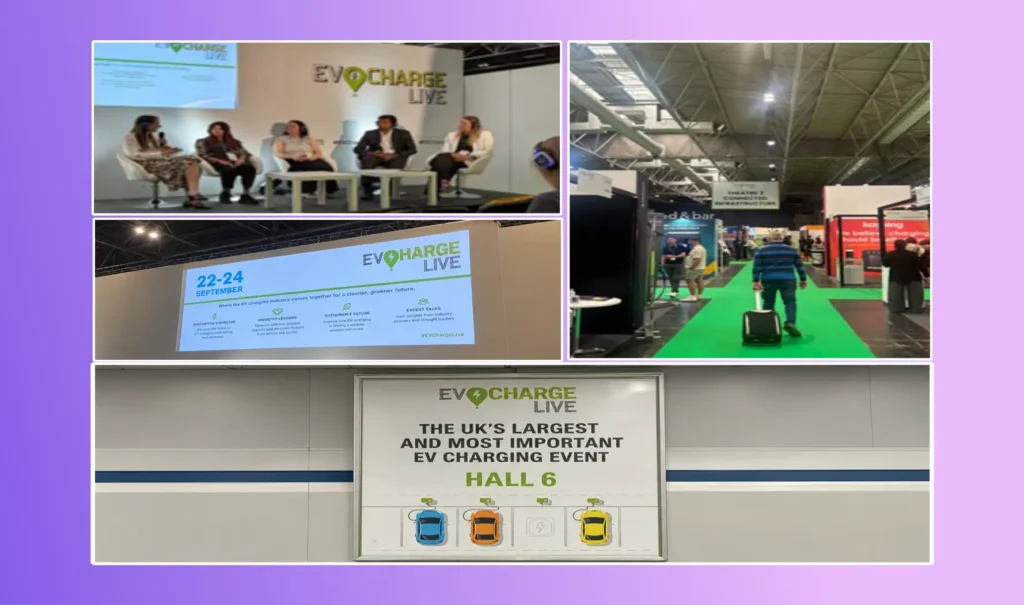
Open Road Access (ORA) joined leaders from across the EV, energy and transport sectors at EVCharge Live UK 2026, as the industry came together to discuss the opportunities and challenges involved in the UK’s transition to electric vehicles.
Held at the NEC Birmingham and co-located with Solar & Storage Live UK, the event brought together more than 15,000 professionals from across EV charging, energy and transport.
ORA’s Director of Partnerships, Policy & Impact, Catherine Marris, spent two days at the event meeting organisations involved in the transition and contributing to panel discussions on the future of EV charging.
For ORA, one question sits at the heart of this conversation: how do we make sure the transition to electric vehicles works for everyone?
Accessibility needs to be part of the transition
The UK’s EV transition is changing not only the vehicles people drive, but the infrastructure they rely on to get around.
For disabled drivers and passengers, that brings significant opportunities. But it also introduces new questions about whether vehicles and charging infrastructure will work for people with a wide range of access needs.
There has already been important progress. PAS 1899, the UK’s accessible charging standard, was introduced in 2022 to provide guidance on making public EV charging more accessible. The standard covers considerations ranging from the physical environment around a chargepoint to the usability of the charging equipment itself.
But disabled people’s experiences show there is still work to do.
Also Read: The Future Of Accessible Taxis And Private Hire – ORA Policy
Recent research involving 486 disabled people found that priorities when using public charging included clear information about cable weight and handling, accessible positioning of components, and level access or dropped kerbs. An overwhelming 96% wanted a map showing accessible chargepoints, while 85% wanted to be able to filter charging locations according to their access needs.
These findings reflect a wider point that ORA hears through our work with disabled people: accessibility isn’t simply about whether infrastructure technically exists. It is about whether someone can confidently plan a journey knowing that it will work for them in practice.
A chargepoint may exist at someone’s destination, for example, but can they get close enough to it? Is there enough room to manoeuvre around their vehicle? Can they lift and connect the cable? Is the screen or payment terminal accessible? And can they find reliable information about all of this before they travel?
Those practical details can determine whether an EV feels like an enabler of independence or another source of uncertainty.
Collaboration is critical
These questions were particularly relevant to the EVCharge Live panel moderated by Catherine on addressing challenges in on-the-road and kerbside charging.
The discussion brought together representatives from local government, industry and the accessibility sector to explore the technical and regulatory challenges associated with charging on public highways and residential streets, as well as how local authorities and chargepoint operators can work together to create more equitable access.
Accessibility cannot be solved by one organisation or one part of the system.
Vehicle manufacturers, chargepoint operators, local authorities, energy providers, national government, standards bodies and organisations representing disabled people all influence different parts of the experience.
That’s why continued collaboration matters so much.
It also means continuing to involve disabled people themselves. As the network develops and new technology emerges, we need to understand not only whether solutions meet technical standards, but how people experience them in the real world.
We want our customers to help us learn
For ORA, this is becoming an increasingly important part of our own work.
We want to engage our customers more closely in understanding what the transition to EVs means for them: what excites them, what concerns them, and what would give them the confidence to make the switch.
Some people may be enthusiastic about moving to an EV. Others may have questions about charging away from home, range, vehicle accessibility, adapting to new technology, or whether they will be able to find a charge point that works for their particular needs.
These aren’t reasons to slow down the transition. They’re reasons to make sure disabled people are involved in shaping it.
ORA already has an electric wheelchair accessible vehicle (eWAV) available to hire, and we’re particularly keen for customers to experience it and tell us what they think.
For somebody who has never used an electric WAV before, hiring can provide an opportunity to experience an EV in everyday life without immediately making the much bigger commitment involved in purchasing one.
What is it like to drive? How does it fit into family life? How easy is charging? What happens on longer journeys? What works particularly well — and what could make the experience better?
Those experiences can help us understand the practical realities of the transition for wheelchair users and their families, while helping customers understand whether an electric vehicle could work for them.
If you’re interested in trying our eWAV, we’d love to hear from you.
Designing around real journeys
One of the themes running through ORA’s wider work on accessible mobility is the importance of looking at whole journeys, rather than individual pieces of transport infrastructure in isolation.
EV charging is no different.
An accessible chargepoint is important, but so is being able to identify it before travelling. The vehicle itself needs to work for the customer. The parking environment needs to provide enough space. The route between the vehicle and surrounding facilities needs to be accessible. And people need confidence that the same journey will work when they make it again somewhere else.
Research and emerging standards are increasingly recognising this. Current work around accessibility information, for example, considers not only the charging equipment but parking space dimensions, surfaces, slopes, step-free access, cable length and weight, assistance facilities, lighting and other characteristics that can determine whether an individual can actually use a charging location.
Getting these details right can benefit far more people than those who identify as disabled.
The opportunity ahead
The transition to EVs represents one of the biggest changes to personal transport in generations.
We have an opportunity to build accessibility into that transition while infrastructure, technology and customer expectations are still developing — rather than attempting to retrofit it later.
That requires standards and good design, but it also requires something less technical: continuing to listen to the people who will actually use the system.
Our time at EVCharge Live reinforced just how many organisations are working on different pieces of this challenge.
ORA wants to continue contributing the perspective of disabled drivers and passengers, learning from our customers as more people experience electric accessible vehicles, and collaborating across sectors to help ensure the transition delivers greater mobility and independence for everyone.
Interested in experiencing an electric wheelchair accessible vehicle? Get in touch with ORA to find out more about trying our eWAV.
.
Follow Us
Google Map Link: https://maps.app.goo.gl/RSUdTXfbeYSmCU9A7
Facebook Link: https://www.facebook.com/openroadaccess/
Instagram Link: https://www.instagram.com/openroadaccess/
LinkedIn Link: https://uk.linkedin.com/company/open-road-access/
YouTube Link: https://www.youtube.com/@OpenRoadAccess
