


The Complete Blue Badge Guide 2026
Everything you need to know about eligibility, applying, parking rules, and the latest changes.
The Blue Badge is one of the most practical pieces of support available to disabled people in the UK. A small blue permit in your windscreen means you can park closer to where you need to be, whether that’s a GP surgery, a supermarket, a family occasion, or somewhere that simply matters to you that day.
But the rules can feel complicated, and they have changed meaningfully over the past few years. This guide covers everything you need to know in 2026: who qualifies, how to apply, where you can legally park, and what has changed recently.
What is the Blue Badge scheme?
The Blue Badge scheme is a national arrangement of parking concessions for disabled people across England, Scotland, Wales, and Northern Ireland. It is administered by local councils, but the eligibility criteria are set nationally.
The badge belongs to you as a person, not to a vehicle. That means you can use it whether you are driving yourself or travelling as a passenger in someone else’s car. It is valid in any vehicle you travel in, as long as you are present.
Who is eligible in 2026?
There are two routes to qualifying: automatic eligibility (no further assessment needed) and assessment-based eligibility (your local council will review your application).
Automatic eligibility
In England, you qualify automatically if you are aged 3 or over and any of the following applies:
- You receive the higher rate mobility component of Disability Living Allowance (DLA)
- You receive the Personal Independence Payment (PIP) mobility component and scored 8 points or more for the ‘moving around’ activity
- You receive the PIP mobility component and scored exactly 10 points for descriptor E under ‘planning and following journeys’, on the grounds that any journey would cause you overwhelming psychological distress (note: 10 points under descriptor D, or 12 points under descriptor F, does not automatically qualify)
- You are registered blind or severely sight impaired
- You receive the War Pensioners’ Mobility Supplement
- You have received a lump sum benefit at tariff levels 1 to 8 of the Armed Forces and Reserve Forces Compensation Scheme, and have been certified as having a permanent and substantial disability causing inability to walk or very considerable difficulty walking
Scotland and Wales operate similar but slightly different automatic criteria; check with your local council for exact details.
Assessment-based eligibility
If none of the automatic criteria apply, you may still qualify if you have an enduring and substantial disability that will last at least three years, and any of the following describes you:
- You are unable to walk, or walking causes you very considerable difficulty (this can be physical or psychological)
- You are at risk of serious harm when walking, or pose a risk of serious harm to others
- You are a driver with severe disability in both arms, making it very difficult or impossible to operate a parking meter
- You are terminally ill with a progressive disease and not expected to live more than 12 months
- A child under three has a medical condition requiring them to stay close to a vehicle for emergency treatment, or needs bulky medical equipment transported with them
Hidden and non-visible conditions
Since 2019, people with hidden or non-visible disabilities have been able to apply under the assessment route. Conditions that may qualify include autism, dementia, Parkinson’s, serious mental health conditions, and anxiety disorders, where the condition makes journeys significantly difficult or dangerous.
Behaviours that councils consider include becoming physically distressed or aggressive, refusing or being unable to walk, wandering away from safe areas without awareness, or experiencing overwhelming anxiety or fear in public spaces. This is not an exhaustive list; each case is assessed individually.
If you are over State Pension age
There is no upper age limit on the Blue Badge. You can apply or renew at any age.
However, the route to automatic eligibility changes significantly once you reach State Pension age. PIP is only available to people who claim it before reaching State Pension age. After that point, if you develop a new condition or disability, you can only claim Attendance Allowance, which covers care needs but has no mobility component. Because the automatic Blue Badge routes are tied to PIP and DLA mobility awards, Attendance Allowance alone does not trigger automatic eligibility.
This means that if you are over State Pension age and not already on PIP or DLA, you will need to apply via the assessment route. Your local council will review your application based on evidence of your condition and how it affects your ability to walk or travel. Supporting letters from your GP, consultant, or occupational therapist can help to strengthen the application.
There are two important exceptions worth knowing:
- If you are already on PIP, your award continues past State Pension age and your automatic Blue Badge eligibility is unaffected.
- If your PIP award ended within the last 12 months, you may still be able to claim PIP even after reaching State Pension age, under the linking rules. Individual circumstances vary, so it is worth speaking to a benefits adviser to check whether this applies to you.
If you are approaching State Pension age and have mobility difficulties, it is worth looking into whether you qualify for PIP before you reach that threshold, as it secures the automatic route and may also open access to other support such as the Motability scheme. It is also worth noting that Attendance Allowance does not qualify you for the Motability scheme; that route is only available through DLA higher rate mobility, PIP enhanced mobility, Armed Forces Independence Payment, or the War Pensioners’ Mobility Supplement. These are complex benefit decisions and a benefits adviser or Citizens Advice can help you understand the options for your individual situation.
How to apply
What you will need
Before you start, gather the following:
- Your National Insurance number (or child reference number if applying for a child)
- Proof of identity (passport, driving licence, or birth certificate)
- Proof of address (utility bill or bank statement dated within the last 12 months)
- A recent passport-style photograph
- Evidence of your condition or benefit (your PIP or DLA award letter, or letters from a doctor, consultant, occupational therapist, or care coordinator, depending on which criteria you are applying under)
- Your current badge number and expiry date, if you are renewing
How to submit your application
Apply online through GOV.UK if you live in England, Scotland, or Wales. If you live in Northern Ireland, apply through NI Direct. Most councils also allow assisted applications if you cannot apply online. Your GP cannot apply on your behalf; the application must come from you or someone acting on your behalf.
The process is the same whether you are applying for the first time or renewing.
If your application is more complex because you are not automatically eligible, Citizens Advice can help you fill in the form. Find your nearest Citizens Advice.
If you are terminally ill
Councils will generally try to fast-track applications from people who are terminally ill, though this is not a guaranteed fixed process. You will need a copy of form SR1, which confirms your terminal illness diagnosis. You can get this from your doctor or consultant. Contact your local council directly before applying and let them know your situation; they may be able to simplify the process and advise which questions you do not need to answer.
Describing how far you can walk
If you are applying under the assessment route and need to describe your walking ability, be as specific as you can. Citizens Advice suggests using bus lengths as a reference: one bus is approximately 11 metres long. Estimate how far you can walk before experiencing pain, breathlessness, or needing to stop and rest. Describe how long it takes and how you walk, for example if you shuffle, take very small steps, or need to stop frequently. The more detail you include, the stronger your application.
How long does it take?
Applications can take up to 12 weeks to process. If you are renewing, start the process at least 6 to 10 weeks before your current badge expires to avoid a gap in cover.
What does it cost?
- England: up to £10
- Scotland: up to £20
- Wales: free
- Northern Ireland: up to £10
You pay after your application has been approved. Payment is by debit or credit card. Be aware of scam websites that charge more than this; always apply through GOV.UK or your local council’s official site.
How long is a Blue Badge valid?
Most badges are valid for three years. Some may be issued for a shorter period depending on individual circumstances. A badge does not renew automatically; you must reapply before it expires.
Where you can park
The Blue Badge gives you specific on-street parking rights across the UK. However, it is not a licence to park anywhere, and the rules vary slightly by local authority, particularly in parts of London.
Where you can park on-street
- Disabled parking bays: free and for as long as you need, unless a time limit is signed
- Pay-and-display bays: free and for as long as the bay allows
- Single or double yellow lines: up to three hours, as long as there is no loading ban in force (loading bans are marked by yellow kerb markings)
- Limited waiting bays: for the full duration, with no time limit, unless signs say otherwise
You must wait at least one hour before returning to the same stretch of road to park again on yellow lines.
Central London: different rules apply
The City of London, Westminster, Kensington and Chelsea, and parts of Camden operate their own concessions and generally do not apply the standard yellow line exemption. They do provide dedicated disabled parking bays. Check with the relevant borough before travelling.
Where you cannot park, even with a Blue Badge
- On red routes (you may stop briefly to drop off or pick up the badge holder only)
- In bus stops, bus lanes, tram lanes, or cycle lanes
- On pedestrian crossings or zigzag markings outside schools
- On double white lines in the middle of the road
- Where a loading ban is in force
- Anywhere you would cause an obstruction or endanger other road users
Off-street car parks
The Blue Badge does not automatically apply in private or off-street car parks, such as those at shopping centres, hospitals, or supermarkets. These are governed by separate rules set by the operator. Many do offer free or discounted parking for Blue Badge holders, but you should always check signage when you arrive.
Displaying your badge correctly
Your badge must be displayed clearly on your dashboard, facing outward, so the front of the badge (showing the wheelchair symbol and your photograph) is readable through the windscreen. In time-limited bays and on yellow lines, you must also display a parking clock set to the time you arrived.
Using your Blue Badge in Europe
The UK Blue Badge is recognised in many European countries, but the rules vary between countries, can differ at a local level within countries, and can change. You should always check the current position on GOV.UK before travelling rather than relying on any third-party guide, including this one.
As of early 2026, a significant number of European countries recognised UK Blue Badges, including most EU member states and several EEA countries. However, recognition is not uniform: some countries apply rules regionally or locally, some require you to use a local parking disc alongside your badge for time-limited concessions, and a small number may not recognise a non-EU-issued badge at all.
France agreed to recognise UK Blue Badges following the UK-France Summit in July 2025, but rules are applied locally, so it is worth checking in advance for the specific areas you plan to visit.
Spain leaves recognition to local administrations, and arrangements are not consistent across the country.
The authoritative and up-to-date source for country-by-country rules is GOV.UK. Check Using a Blue Badge abroad before any European trip, and check again close to your travel date if the position may have changed.
What is changing in 2026?
PIP welfare reform and Blue Badges
The Department for Work and Pensions is reviewing its PIP assessment criteria as part of its wider welfare reform programme. At the time of writing, no final rules have been confirmed and no firm implementation date has been set in legislation. Reporting suggests changes could affect new applicants at some point in late 2026 or beyond, but this remains subject to the outcome of the review.
The DWP has stated that PIP eligibility changes will not immediately remove support for existing claimants, and those already receiving PIP-linked benefits should retain their current entitlement in the near term. However, the position is live and could change. If you or someone you support is approaching a new PIP claim or a scheduled review, it is worth checking the latest GOV.UK guidance and seeking advice from Citizens Advice or a benefits adviser.
Scam websites
Local councils have flagged an increase in fraudulent websites charging far more than the official fee. Always apply through GOV.UK or your council’s own website. A legitimate Blue Badge application costs no more than £10 in England.
If your application is refused
You will receive a letter from the council explaining the decision. You can ask for the decision to be reconsidered, and it is generally worth doing so if you cannot walk more than 80 metres, or if you have difficulty operating a parking meter due to problems with your arms.
In Scotland, the appeals process is formal and must be initiated within 28 days of the decision.
In England and Wales, there is no fixed appeals process, but you can write to your council to challenge the decision and provide additional supporting evidence.
Misuse of Blue Badges
Using a Blue Badge fraudulently is a criminal offence in England, Scotland, and Wales under section 117 of the Road Traffic Regulation Act 1984. The maximum fine on conviction is £1,000. Badges can only be used when the badge holder is present; lending your badge to someone who is travelling without you is misuse.
If your badge is lost, damaged, or stolen, contact your local council to arrange a replacement.
A note on transport beyond the car park
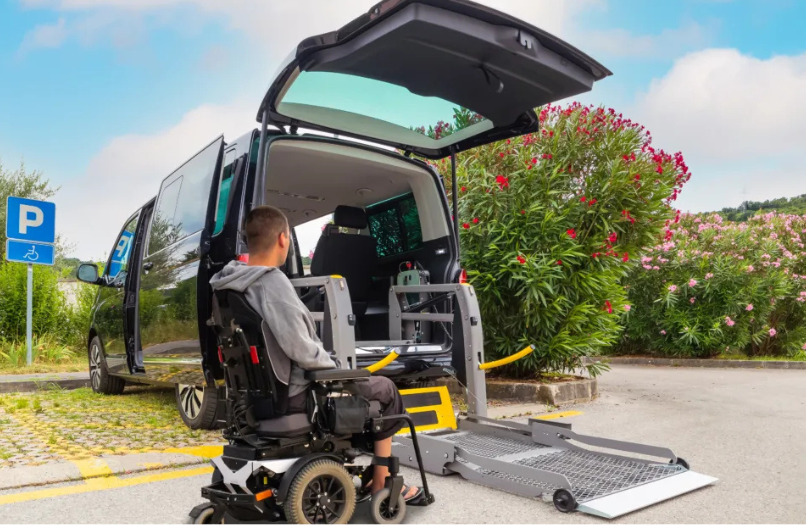
The Blue Badge helps enormously with parking. But for wheelchair users and disabled people, the challenge of getting from A to B is often much bigger than finding a space.
The Motability scheme is one option for those who qualify through PIP or DLA, but as Scope notes, it requires a qualifying benefit award and is not available to people receiving Attendance Allowance only. For those who do not need a wheelchair accessible vehicle every day of the year, who need transport while waiting for a Motability vehicle, or who want a flexible arrangement without a long-term commitment, hire is a practical alternative.
If you or someone you care for needs a wheelchair accessible vehicle (WAV) for a holiday, a family occasion, a hospital appointment, or any period when your usual transport is not enough, ORA offers flexible hire from one day to one year, with nationwide door-to-door delivery, all-inclusive pricing, and no difference in cost between vehicle sizes.
If you’re looking for wheelchair accessible vehicle hire, get a quote.
Last updated: May 2026. This guide is for general information and does not constitute legal or benefits advice. For your specific circumstances, always check GOV.UK or speak to your local council, Citizens Advice, or a qualified benefits adviser.
Sources
