


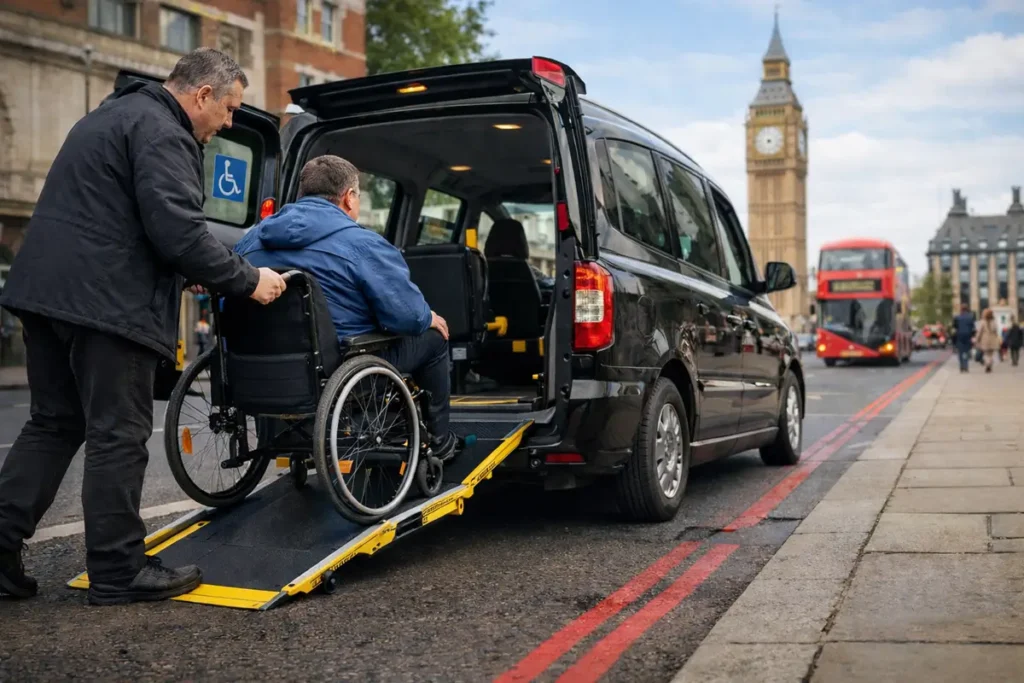
Open Road Access (ORA) has submitted its response to the UK Government’s consultation on taxi and private hire vehicle (PHV) licensing changes, calling for accessibility, flexibility and real-world usability to be central to any changes.
London, UK — April 2026 — Open Road Access (ORA), the accessible transport provider working across rehabilitation, healthcare and independent living, has responded to the Department for Transport’s consultation on reforming taxi and PHV licensing.
While the proposals aim to improve consistency, safety and enforcement, ORA’s submission highlights a critical risk: without careful design, reform could reduce access to already limited wheelchair accessible transport.
Drawing on its work with individuals, families, case managers and rehabilitation professionals, ORA is urging the Government to ensure that reforms reflect how accessible transport is actually used in practice.
Transport as a critical enabler of rehabilitation
For many people, particularly those recovering from serious injury or managing long-term conditions, transport is not simply a convenience — it is a key part of recovery and independence.
Reliable access to transport enables:
- regular attendance at physiotherapy and rehabilitation appointments
- return to work, education and social participation
- confidence in planning day-to-day life
However, the current taxi and PHV system often does not meet these needs.
ORA consistently hears from people who:
- Struggle to secure wheelchair accessible vehicles (WAVs)
- Experience long wait times or last-minute cancellations
- Lack confidence that the correct vehicle will arrive
- Cannot arrange consistent, repeat journeys for ongoing care
“When transport isn’t reliable, recovery is disrupted,” said David Dew-Veal, CEO of Open Road Access. “People miss appointments, delay progress, and lose confidence. That’s why this consultation matters: it’s about whether the system works in real life.”
A constrained system under pressure
At the centre of the issue is a structural imbalance.
Wheelchair accessible vehicles make up only a small proportion of the national PHV fleet — estimated at around 2%. At the same time, demand for accessible transport is dispersed across geographies, with people frequently travelling across local authority boundaries for healthcare, education and specialist services.
This means that accessibility depends not only on regulation, but on how flexibly a limited number of vehicles can be deployed.
ORA’s response warns that reforms which restrict cross-border working or impose rigid local requirements could unintentionally reduce availability, making an already constrained system more difficult to access.
Supporting changes, with the right safeguards
Open Road Access supports the Government’s ambition to improve consistency and accountability in taxi and PHV licensing.
There is clear value in:
- Stronger and more consistent enforcement
- Clearer licensing frameworks
- Better alignment with local transport planning
However, ORA emphasises that accessible transport operates differently from standard provision.
For most vehicles, localised supply may be sufficient. For specialist accessible vehicles, it often is not.
“Accessible transport relies on flexibility,” said Catherine Marris, ORA’s Director of Partnerships, Policy & Impact. “If we design the system as if all vehicles are the same, we risk making access worse for the people who rely on it most.”
ORA’s key recommendations
ORA’s submission sets out practical steps to ensure reform improves accessibility outcomes.
Protect and expand the WAV supply
Accessible transport depends on having enough vehicles in the system.
ORA calls for licensing policies to reflect:
- The limited supply of WAVs
- The additional cost and complexity of conversion
- Current challenges in transitioning to electric accessible vehicles
Without flexibility, policies such as strict age limits or emissions requirements could reduce supply further.
Maintain cross-border flexibility
Given the low number of accessible vehicles and dispersed demand, cross-border operation is essential.
Allowing vehicles to operate across licensing boundaries enables:
- Better utilisation of existing fleets
- Reduced wait times
- Greater likelihood of securing an appropriate vehicle
For accessible transport, flexibility is not a workaround — it is fundamental to access.
Introduce a national accessibility baseline
ORA supports the creation of a statutory national baseline for accessibility standards, including:
- Disability awareness and assistance requirements
- Clear passenger information
- Consistent complaints and enforcement processes
This would reduce variation between local areas and improve confidence for passengers.
Create a streamlined pathway for accessible operators
Specialist accessible operators often navigate multiple, fragmented licensing systems.
ORA recommends a simplified pathway for operators with significant accessible provision, reducing administrative burden and enabling more efficient deployment of vehicles.
Strengthen accessibility requirements for platforms
Digital ride-hailing platforms have improved convenience but have not resolved accessibility challenges.
ORA calls for:
- Clearer accessibility information for passengers
- The ability to request appropriate vehicles with confidence
- Accountability for meeting accessibility standards
“Technology should enable access, not obscure it,” said Dew-Veal. “We need transparency and accountability built into the system.”
A broader opportunity for inclusive transport
If designed correctly, licensing reform offers an opportunity to improve not only regulation but outcomes.
Better accessible transport supports:
- Faster and more consistent rehabilitation
- Greater participation in work and education
- Reduced isolation
- Increased independence
It also creates an environment where innovation in accessible transport can grow — supporting new models, services and partnerships.
However, these benefits depend on ensuring that accessibility is treated as a core requirement, not an afterthought.
Looking ahead
Transport is often framed as a logistical issue. In reality, it underpins access to healthcare, employment and everyday life.
For the people ORA works with, the question is simple: can I get where I need to go, reliably and safely?
That is the standard any reform must meet.
Open Road Access will continue to engage with Government, policymakers and industry partners as proposals develop, bringing real-world insight from individuals, families and professionals working across rehabilitation and care.
“We want to help make this work,” said Marris. “Accessibility isn’t a constraint on the system — it’s what makes the system work for everyone.”
About Open Road Access (ORA)
Open Road Access (ORA) is transforming accessible transport across the UK, providing flexible Wheelchair Accessible Vehicle (WAV) hire to individuals, families and professionals.
Working closely with the rehabilitation, healthcare and legal sectors, ORA delivers nationwide vehicle access with flexible terms, supporting independence, recovery and participation.
